Every custom order involves a logo that belongs to someone, and a logo authorization letter is the one page that settles it. Most of the time nobody thinks about it, because the logo belongs to the buyer and the buyer is ordering their own shirts. Occasionally it does not, and that is when the question of authorization stops being paperwork.
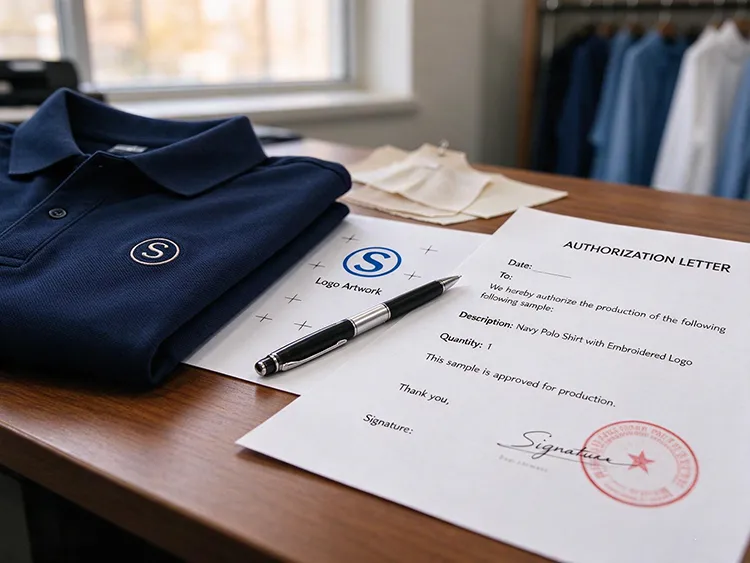
The short version
You own the artwork. You give us permission to reproduce it on a specific quantity of garments, for a specific order. That permission does not extend to anything else, it does not transfer ownership, and it ends when the order is finished.
We do not register your logo, we do not resell it, and we do not use it to approach your customers.
When a logo authorization letter is required
For most orders, a written statement is enough. An email saying “this is our company logo, we own it, please produce 500 polos with it” is a legitimate record. It takes ten seconds and it protects both sides.
For three categories we ask for more.
Brand marks that are registered trademarks, especially well known ones. A signed authorization letter on your letterhead, naming us, the quantity, the territory and the period, is the standard document.
Sports clubs, universities, schools, event brands and licensed characters. These are the highest risk category in the whole trade, because the rights holder is usually an organisation with a legal department and a licensing programme.
Anything where the artwork arrives without context. A logo file with no company name, no website and no explanation gets a question, not a quotation.
Why the letter protects you more than it protects us
A factory that prints a logo without permission is exposed. The buyer who ordered it is exposed too, and usually more, because the buyer is the one importing the goods into a market where the rights holder can act.
Customs in the EU and the US can detain goods that infringe a trademark, and the importer is the party who has to prove the goods are legitimate. A single signed letter is what turns that conversation from a seizure into a release.
That is the honest reason we ask early. Not because we enjoy paperwork, but because the day the shipment is held, the letter is the only thing that helps.
What we will not produce
We will not produce counterfeit goods, and that includes close copies: a logo altered slightly to avoid an exact match is still an infringement in most jurisdictions, and it is a clear one when the intent is written down in an email.
We will not take a repeat order for a branded item from someone who was not the original customer unless the brand confirms it.
If an inquiry raises a question, we ask it before quoting. That is usually all it takes: the buyer sends the letter, or explains that the mark is their own, and the order moves on. Settling it at that stage costs nothing, and settling it once the goods are on the water costs a great deal.
The artwork file itself
A vector file is better than a photograph, and it is worth asking your designer for the original rather than sending a screenshot of a business card.
When we redraw or digitise your artwork to make it producible, the redrawn file is a technical derivative. We keep it for your reorders, we do not share it, and if you ask for a copy we will send it.
If you want the file deleted after the order, say so in writing and we will delete it. If you want an NDA before sending the file, we will sign one. Both requests are normal and neither is an insult.
Can we show your order in our portfolio
Only with permission, and we default to no for branded work. A photograph of finished goods carrying someone else’s mark is a small infringement of its own, and we would rather ask than assume.
If you are happy for us to show it, a one line email is enough. Many buyers agree once the goods have shipped, because a case study helps them too.
If you do not have a registered trademark
Most of our customers do not, and that is fine.
A logo you designed and have used in trade is yours in most jurisdictions even without registration, through use. What you cannot do is claim rights you do not have over a mark that someone else registered first.
If your brand is new and unregistered, the practical answer is simple: tell us it is yours, and be accurate about it. We are not running a trademark search on every order. We are making sure that if a question is ever asked, there is a record showing who said what.
What to send with the order
The artwork as a vector file, the size and placement you want, a written statement that you own or are licensed to use it, and if it is a registered brand, the signed authorization letter.
Four items, one email. It is the cheapest insurance in the whole order.