Buyers compare cotton shirts by weight and price, and skip the pique vs jersey question that explains most of the difference they can feel. It is one of the few choices in a polo that cannot be fixed later, and it is usually decided by whoever quotes the job.
Pique and jersey can both be 100 percent cotton, both be 180 gsm, and both look like gray fabric in a photo. On a table, in the hand, and after ten washes, they behave like two different products.
One machine, two settings
A circular knitting machine feeds yarn into needles arranged in a circle. What the needles do next is the whole story. Knit every needle on every revolution and you get jersey. Tuck some stitches and skip others, and the surface lifts into pique.
Same yarn, same machine, two fabrics that feel nothing alike.
Jersey, the single knit
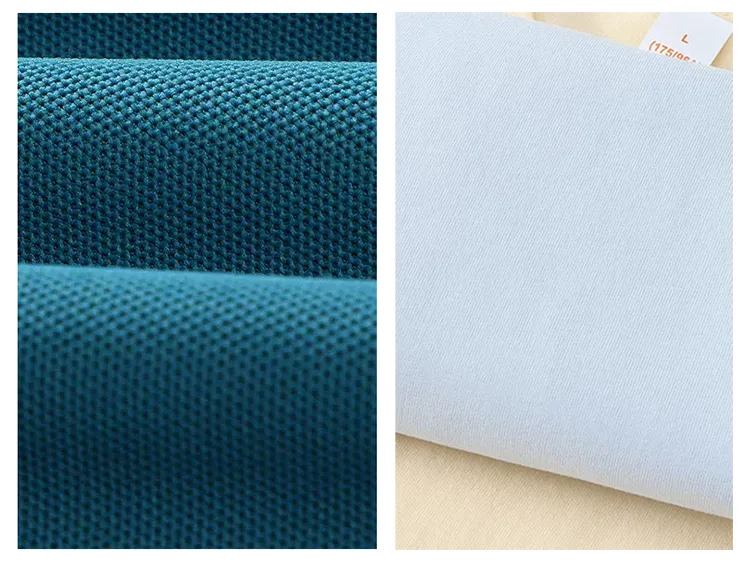
Jersey is the simplest and the cheapest. One set of needles, one face, smooth on the front and slightly looped on the back.
It is thin, it drapes, it stretches easily, and it curls at the cut edges, which is why a jersey t-shirt needs a ribbed neckband rather than a simple folded hem. It takes print beautifully because the surface is flat. It also shows every irregularity in the body underneath, which is why cheap jersey reads as cheap.
Most promotional t-shirts are jersey. So are most fashion t-shirts, for different reasons: jersey is the best surface in the family for a large print.
Pique, the one with texture
Pique uses tuck stitches to build a small raised pattern, a fine waffle across the surface. It is the classic polo knit, and the reason is structural rather than traditional.
The texture traps a layer of air, so a 180 gsm pique feels cooler than a 180 gsm jersey in hot weather. The stitches are denser and less mobile, so the fabric holds its shape and does not cling. And it resists the crumpled look that jersey develops after a day at a desk.
Pique is harder to print on. The ink sits on the raised points rather than sinking into a flat surface, so a large solid print needs a heavier deposit and can crack along the knit lines. Embroidery, by contrast, works better on pique than on jersey, because the denser structure supports the stitch.
If you are making polos and you want them to look like polos rather than like t-shirts with collars, pique is the reason.
The third name you will hear
There is a third knit in this family, interlock. It runs two sets of needles and comes out smooth on both faces, thicker and more stable than jersey, and it does not curl at the cut edge.
You will find it in underwear, base layers, baby clothing and better retail t-shirts. You will almost never find it in a work polo. Interlock costs more than pique and does a job that pique already does at a lower price. It earns its price only when the shirt is being sold to a shopper who will judge it in the hand. For uniforms, that shopper does not exist.
What this means for decoration
Print lives on the surface, so the flatter the surface the better. Jersey wins, pique loses.Embroidery needs structure to support the stitch, so the order reverses: pique holds a logo better, jersey struggles on a soft, thin body.
If your artwork is a large photographic print and the garment is a polo, you have a conflict. Either simplify the artwork, or accept that a jersey polo will print better than a pique one and lose some of the polo character.
Weight is a separate axis
A 220 gsm jersey and a 220 gsm pique do not feel the same, even though the number on the specification sheet is identical.
Pique reads lighter than its weight because of the air in the texture. Jersey reads heavier because it clings. This is why two suppliers can both quote 200 gsm cotton and deliver shirts that feel like they came from different factories. The number is right in both cases. The structure is different.
How to tell them apart on a workbench
Stretch a corner and look at the light coming through. Pique shows a regular grid of small holes. Jersey shows an even, slightly transparent field.Cut edge test: jersey curls, pique curls less.Turn it inside out. Pique has a flatter back with long floats where the tuck stitches skip. Jersey has a uniform looped back.
What to put in your specification
Name the structure, not just the weight. “200 gsm cotton knit” leaves the choice to whoever is quoting, and the cheapest interpretation will be jersey.Write “cotton pique, 200 gsm, reactive dyed” for a polo, “cotton jersey, 180 gsm” for a printed tee. Three words more in the spec sheet is the difference between getting what you meant and getting what was quoted.