OEKO-TEX Standard 100, REACH and GB 18401 end up in the same sentence on a lot of quotations, as if they were variations of one thing. They are not. OEKO-TEX Standard 100 is a voluntary certification, REACH is European law, and GB 18401 is a Chinese national standard. They cover different risks.
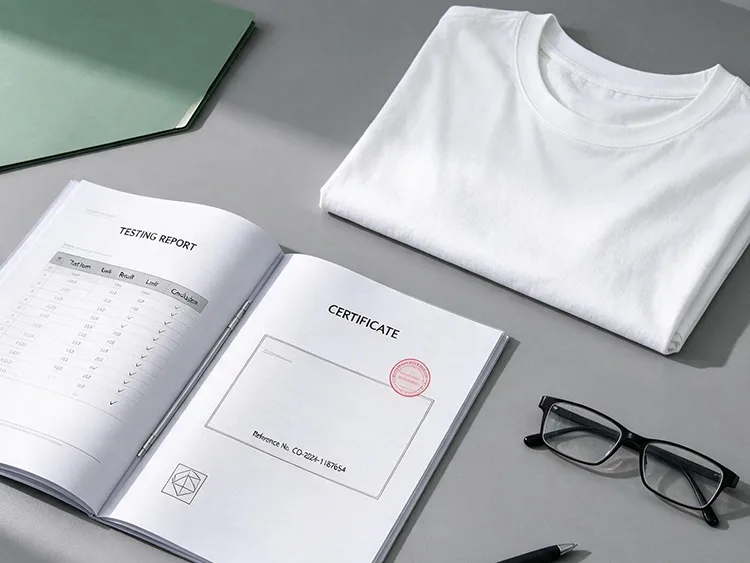
OEKO-TEX Standard 100, a voluntary label
It is a testing and certification system run by the international OEKO-TEX association. A fabric or garment is tested for harmful substances: restricted azo dyes, formaldehyde, heavy metals, pesticide residues, chlorinated phenols, phthalates, and a long list of others.
It is not a law. Nothing requires a t-shirt to be certified. It is a private mark that a supplier pays to use, which is why you see it on some products and not on others at the same quality level.
The label comes in four product classes, and the class matters more than the logo:
Class I covers articles for babies and children under three.
Class II covers articles with a large area in contact with skin, which is most clothing.
Class III covers articles not in contact with skin, such as jackets and outerwear.
Class IV covers decoration and furnishing materials.
A certificate issued for Class III does not cover a t-shirt. This is the single most common misuse of the label, sometimes by accident and sometimes not.
What it does not cover: durability, color fastness, shrinkage, construction quality, or where the cotton came from. A certified fabric can still be a bad fabric.
REACH, European law
REACH is the EU regulation on chemicals. It applies to anything placed on the European market, whether or not anyone has a certificate.
Two parts matter to a garment buyer.
The restricted substances list in Annex XVII sets legal limits. Azo dyes that split into carcinogenic aromatic amines are restricted, with a 30 mg/kg limit for the amines in the finished article. Formaldehyde is limited under entry 72, at 75 mg/kg for textiles worn in direct contact with skin.
The candidate list of substances of very high concern works differently. If an article contains one above 0.1 percent by weight, the supplier has information duties, and importers have notification duties under the waste framework rules.
One correction worth knowing, because it circulates widely: the 0.080 mg/m3 formaldehyde limit that people quote at trade shows is an indoor air emission limit. It applies to articles that release formaldehyde into indoor air, such as some wood panels. It is not the limit for a shirt. The shirt limit is the 75 mg/kg in Annex XVII.
GB 18401, the Chinese national standard
GB 18401 is mandatory for textiles sold in China. It classifies products into three safety categories:
Class A, for infants and young children.
Class B, for products in direct contact with skin.
Class C, for products not in direct contact with skin.
Formaldehyde limits follow the class: 20 mg/kg for A, 75 for B, 300 for C. The standard also covers pH, color fastness to water and perspiration, azo dyes and odour.
An export order made in China is normally tested to Class B if the garment is worn next to skin, which happens to line up with the REACH limit for formaldehyde. That alignment is convenient, not coincidental.
How to verify a certificate
A PDF with a logo on it proves nothing. Five checks settle it.
The certificate number, which should be verifiable with the issuing institute.
The scope, which must name the article or the fabric actually in your order, not a category.
The product class, which must be the one your garment belongs to.
The validity date, because these certificates expire.
The test report, which should describe the sample, the color and the date it was tested. A certificate for a white fabric is not evidence for a black one.
What you should expect from a supplier
A good supplier tells you which fabrics have current reports and which do not, rather than sending a certificate that belongs to a different article.
Stock fabrics vary. Some of what we hold carries a current report and some does not, and we tell you which is which for the specific fabric and color in your order rather than send a certificate that belongs to a different article. Where a report is missing and the order is large enough to carry the cost, we will have the fabric tested and send the results with the shipment. What we will not do is put a certification logo on a page for a product that has not been tested, which happens in this industry often enough that the question is worth asking every time.